Into an AnimalTransformation Fiction Human AgainBra
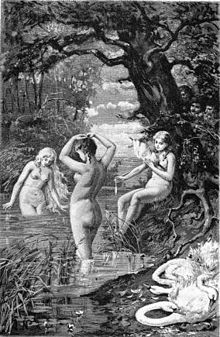
Valkyries, having shed their swan skins, appear equally swan maidens
Therianthropy is the mythological ability of human beings to metamorphose into other animals by means of shapeshifting. It is possible that cave drawings plant at Les Trois Frères, in France, describe ancient beliefs in the concept.[ citation needed ]
The best-known form of therianthropy is found in stories of werewolves.
Etymology [edit]
The term "therianthropy" comes from the Greek theríon [θηρίον], significant "wild creature" or "beast" (implicitly mammalian), and anthrōpos [ἄνθρωπος], pregnant "human being". It was used to refer to animal transformation folklore of Europe as early equally 1901.[i] Sometimes the term "zoanthropy" is used instead.[ii]
Therianthropy was used to describe spiritual beliefs in animate being transformation in a 1915 Japanese publication, "A History of the Japanese People from the Earliest Times to the Finish of the Meiji Era".[3] 1 source, "The Human Predator", raises the possibility the term may take been used as early on as the 16th century in criminal trials of suspected werewolves.[4]
History of therianthropy and theriocephaly [edit]
Therianthropy refers to the fantastical, or mythological, power of some humans to modify into animals.[5] Therianthropes are said to modify forms via shapeshifting. Therianthropy has long existed in mythology, and seems to exist depicted in ancient cave drawings[vi] such as The Sorcerer, a pictograph executed at the Palaeolithic cave drawings found in the Pyrénées at the Les Trois Frères, France, archeological site.
'Theriocephaly' (Gr. "animal headedness") refers to beings which accept an brute caput attached to an anthropomorphic, or human, trunk; for example, the brute-headed forms of gods depicted in ancient Egyptian organized religion (such as Ra, Sobek, Anubis).
Mythology of homo shapeshifting [edit]
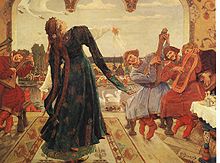
Shapeshifting in folklore, mythology and anthropology generally refers to the alteration of physical appearance from that of a human to that of some other species. Lycanthropy, the transformation of a human into a wolf (or werewolf), is probably the best known course of therianthropy, followed by cynanthropy (transformation into a dog) and ailuranthropy (transformation into a true cat).[7] Werehyenas are present in the stories of several African and Eurasian cultures. Ancient Turkic legends from Asia talk of form-changing shamans known as kurtadams, which translates to "wolfman".[ commendation needed ] Ancient Greeks wrote of kynanthropy, from κύων kyōn [viii] (or "canis familiaris"), which applied to mythological beings able to alternate between domestic dog class and human form, or who possessed combined dog and human anatomical features.[ citation needed ]
The term existed by at least 1901, when it was applied to stories from Cathay nearly humans turning into dogs, dogs becoming people, and sexual relations between humans and canines.[9] Anthropologist David Gordon White called Central Asia the "vortex of cynanthropy" because races of dog-men were habitually placed at that place past ancient writers. The weredog or cynanthrope is also known in Timor. It is described as a human-canine shapeshifter who is capable of transforming other people into animals, fifty-fifty against their will.[ commendation needed ]
European folklore features werecats, who tin can transform into panthers or domestic cats of an enlarged size.[ten] African legends depict people who turn into lions or leopards, while Asian werecats are typically depicted as becoming tigers.[ citation needed ]
Skin-walkers and naguals [edit]
Some Native American and Commencement Nation legends talk about skin-walkers—people with the supernatural ability to turn into any animal they desire. To do and then, however, they first must be wearing a pelt of the specific brute. In the folk faith of Mesoamerica, a nagual (or nahual) is a human being existence who has the power to magically turn themselves into animal forms—most unremarkably donkeys, turkeys, and dogs—just can also transform into more than powerful jaguars and pumas.[ commendation needed ]
Animal ancestors [edit]
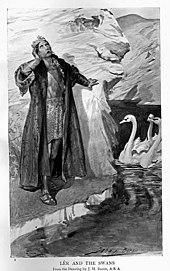
Stories of humans descending from animals are found in the oral traditions for many tribal and clan origins. Sometimes the original animals had assumed human form in lodge to ensure their descendants retained their man shapes; other times the origin story is of a homo marrying a normal animal.
North American ethnic traditions mingle the ideas of behave ancestors and ursine shapeshifters, with bears frequently beingness able to shed their skins to assume human form, marrying man women in this guise. The offspring may be creatures with combined anatomy, they may exist very cute children with uncanny strength, or they may be shapeshifters themselves.[11]
P'an Hu is represented in various Chinese legends every bit a supernatural domestic dog, a domestic dog-headed man, or a canine shapeshifter that married an emperor's girl and founded at least 1 race. When he is depicted as a shapeshifter, all of him can become human except for his head. The race(southward) descended from P'an Hu were often characterized by Chinese writers as monsters who combined human and dog anatomy.[12]
In Turkic mythology, the wolf is a revered animal. The Turkic legends say the people were descendants of wolves. The legend of Asena is an old Turkic myth that tells of how the Turkic people were created. In the legend, a minor Turkic village in northern Prc is raided by Chinese soldiers, with one babe left behind. An sometime she-wolf with a sky-blueish mane named Asena finds the baby and nurses him. She later gives birth to half-wolf, half-human cubs who are the ancestors of the Turkic people.[13] [14]
Shamanism [edit]
Ethnologist Ivar Lissner theorised that cave paintings of beings with human and non-human being brute features were not physical representations of mythical shapeshifters, simply were instead attempts to depict shamans in the procedure of acquiring the mental and spiritual attributes of various beasts.[xv] Religious historian Mircea Eliade has observed that beliefs regarding animal identity and transformation into animals are widespread.[16]
Animate being spirits [edit]

In Melanesian cultures there exists the conventionalities in the tamaniu or atai, which describes the animal counterpart to a person.[17] Specifically amid the Solomon Islands in Melanesia, the term atai means "soul" in the Mota language and is closely related to the term ata, meaning a "reflected image" in Maori and "shadow" in Samoan. Terms relating to the "spirit" in these islands such every bit figona and vigona convey a being that has not been in human form[18] The fauna counterpart depicted, may take the course of an eel, shark, lizard, or some other creature. This animal is considered to exist corporeal, and can understand human spoken language. It shares the aforementioned soul as its chief. This concept is found in similar legends which have many characteristics typical of shapeshifter tales. Among these characteristics is the theory that death or injury would affect both the human and animal form at once.[17]
Psychiatric aspects [edit]
Amidst a sampled gear up of psychiatric patients, the belief of being office fauna, or clinical lycanthropy, is generally associated with severe psychosis, but not always with any specific psychiatric diagnosis or neurological findings.[19] Others regard clinical lycanthropy as a delusion in the sense of the cocky-disorder found in melancholia and schizophrenic disorders, or as a symptom of other psychiatric disorders.[20]
Mod therianthropy [edit]
Therians are individuals who believe or feel that they are non-human animals in a not-biological sense. While therians mainly attribute their experiences of therianthropy to either spirituality or psychology, the style in which they consider their therian identity is not a defining characteristic of therianthropy; as long as a person identifies their sense of self every bit being that of a not-human animal, they can be considered a therian.[21] [22] The creature which a therian identifies as is known by the community as a "theriotype", and this can refer to either the animal they identify as or, more than specifically, their ain non-human animal identity. For example, a therian who believes in reincarnation may utilise the word "theriotype" to refer specifically to their past life or, more than more often than not, to indicate that they are speaking about the animal species they identify as. Therians often use the term "species dysphoria" to describe their feelings of disconnect from their homo bodies and their underlying desire to live as their theriotype.[23] The concept of species dysphoria has often been compared to gender dysphoria, in that there is a like sense of incongruence between the person's concrete body and their internal sense of self. Some non-man identifying people oppose this comparison, stating that "they are separate … identities". Others intentionally parallel the 2, highlighting the similarities.[24] Species dysphoria, or species identity disorder, has been proposed as a mental disorder.[25] A at present-defunct therian website suggested a criteria for a diagnosis, based on the diagnosis of gender dysphoria. Gerbasi et al. noted the "hitting" similarities between species and gender dysphoria, leading them to tentatively advise a medical diagnosis of species identity disorder.[25] Others have compared species dysphoria with Torso Dysmorphic Disorder, terming it "species dysmorphia" instead.[26] A participant in Proctor's newspaper stated that they would consider information technology a form of neurodiversity, rather than a medical diagnosis, "unless it had major and negative impact on someone'southward life".[27] The identity "transspecies" is used by some, furthering the similarities between identifying as a different species and a different gender.[28]
Prevalence [edit]
In an online community survey of 523 non-human identifying people, 75.1% said they experienced species dysphoria, and eight.2% were unsure.[29] In a survey of 408 furries, a quarter responded that they experienced species dysphoria (although furries and otherkin are two separate, but often intersecting, groups).[30]
Shifting [edit]
Many therians describe experiences of temporarily feeling more in bear upon with their theriotype than they do at other times, and this miracle is known by the community as "shifting", with the experiences being known as "shifts". Shifts tin vary indefinitely in the length of time for which they are experienced, and the intensity with which they are felt. They tin can also be triggered intentionally, or unintentionally, usually by stimuli relating to a person'due south theriotype. While shifting is often regarded as a positive experience, the disruption acquired by unintentional triggers, and heightened feelings of species-dysphoria, can too pb to therians experiencing shifts equally negative experiences too. Shifts are commonly experienced in a state of consciousness, although dream shifts (in which a therian might really believe they have the body of their theriotype) are an exception to this. Some therians attribute their knowledge of their own therianthropic identities to their experiences of shifting. For example, a wolf therian might begin to place as a wolf later on experiencing dreams in which their body takes the form of a wolf.
The therian community is mostly considered to be a subculture of the otherkin community, which consists of individuals who identify as or connect with any fictional or non-fictional being. However, different otherkin, therians do not identify as non-fictional beings, and the two movements are culturally and historically distinct.[23] [ folio needed ]
Run into also [edit]
- Therianthropy in pop culture
- Banjhakri and Banjhakrini
- Cynanthropy
- Furry fandom
- Kelpie
- Nagual
- Otherkin
- Selkie
- Shapeshifting
- Skin-walker
- Theriocephaly
- Werecat
- Werewolf
- Werehyena
- Werejaguar
- Wererat
- Zoomorphism
- Human–animal hybrid
Notes and references [edit]
- ^ De Groot, J.J.Grand. (1901). The Religious Arrangement of Cathay: Book Iv. Leiden: Brill. p. 171.
- ^ Guiley, R.E. (2005). The Encyclopedia of Vampires, Werewolves & Other Monsters. New York: Facts on File. p. 192. ISBN0-8160-4685-9.
- ^ Brinkley, Frank; Dairoku Kikuchi (1915). A History of the Japanese People from the Primeval Times to the End of the Meiji Era. The Encyclopædia Britannica Co.
therianthropy.
- ^ Ramsland, Katherine (2005). The Human Predator: A Historical Chronicle of Serial Murder and Forensic Investigation. Berkley Hardcover. ISBN0-425-20765-X.
- ^ Edward Podolsky (1953). Encyclopedia of Aberrations: A Psychiatric Handbook. Philosophical Library.
- ^ "Trois Freres". Encyclopædia Britannica . Retrieved 2006-12-06 .
- ^ Greene, R. (2000). The Magic of Shapeshifting. York Beach, ME: Weiser. p. 229. ISBNane-57863-171-8.
- ^ kynanthropy; Woodhouse'south English-Greek Lexicon; (1910)
- ^ De Groot, J.J.M. (1901). The Religious System of China: Book Iv. Leiden: Brill. p. 184.
- ^ Greene, Rosalyn (2000). The Magic of Shapeshifting. Weiser. p. 9.
- ^ Pijoan, T. (1992). White Wolf Woman & Other Native American Transformation Myths . Little Stone: Baronial House. p. 79. ISBN0-87483-200-four.
- ^ White, D.G. (1991). Myths of the Domestic dog-Man . Chicago: The University of Chicago Press. p. 150. ISBN0-226-89509-two.
- ^ Cultural Life – Literature Turkey Interactive CD-ROM; 2007-08-xi.
- ^ T.C. Kultur Bakanligi; Nevruz Celebrations in Turkey and Central Asia Archived 2007-04-04 at the Wayback Auto; Ministry building of Culture, Commonwealth of Turkey; accessed 2007-08-11
- ^ Steiger, B. (1999). The Werewolf Book: The Encyclopedia of Shape-Shifting Beings. Farmington Hills, MI: Visible Ink. ISBN1-57859-078-7.
- ^ Eliade, Mircea (1965). Rites and Symbols of Initiation: the mysteries of nascence and rebirth. Harper & Row.
- ^ a b Hamel, F. (1969). Human Animals, Werewolves & Other Transformations. New Hyde Park, NY: University Books. p. 21. ISBN0-8216-0092-3.
- ^ Ivens, Walter (January 1934). "The Diversity of Culture in Melanesia". The Journal of the Royal Anthropological Institute of Bully Britain and Republic of ireland. 64: 45–56. doi:ten.2307/2843946. JSTOR 2843946.
- ^ Keck PE, Pope HG, Hudson JI, McElroy SL, Kulick AR (February 1988). "Lycanthropy: alive and well in the twentieth century". Psychol Med. xviii (one): 113–xx. doi:10.1017/S003329170000194X. PMID 3363031.
- ^ Garlipp, P; Godecke-Koch T; Dietrich DE; Haltenhof H. (January 2004). "Lycanthropy—psychopathological and psychodynamical aspects". Acta Psychiatrica Scandinavica. 109 (1): nineteen–22. doi:10.1046/j.1600-0447.2003.00243.x. PMID 14674954. S2CID 41324350.
- ^ Laycock, Joseph P. (2012). "We Are Spirits of Some other Sort". Nova Religio: The Journal of Alternative and Emergent Religions. xv (three): 65–90. doi:10.1525/nr.2012.15.three.65.
- ^ Cohen, D. (1996). Werewolves . New York: Penguin. p. 104. ISBN0-525-65207-8.
- ^ a b Lupa (2007). A Field Guide to Otherkin. Megalithic Books. ISBN978-1905713073.
- ^ Robertson, Venetia; Delano, Laura (2006). "The Law of the Jungle: Self and Community in the Online Therianthropy Movement". The Pomegranate. Equinox Publishing Ltd: 274. doi:10.1558/pome.v14i2.280.
- ^ a b Gerbasi, Kathleen; Bernstein, Penny; Conway, Samuel; Scaletta, Laura; Privitera, Adam; Paolone, Nicholas; Higner, Justin (2008-08-01). "Furries from A to Z (Anthropomorphism to Zoomorphism)". Society and Animals. 16: 197–222. doi:10.1163/156853008X323376.
- ^ Clegg, Helen; Collings, Roz; Roxburgh, Elizabeth C (2019). "Therianthropy: Wellbeing, Schizotypy, and Autism in Individuals Who Cocky-Identify as Non-Human being". Guild & Animals. 27: 403–426.
- ^ Proctor, Devin (2018-09-29). "Policing the Fluff: The Social Construction of Scientistic Selves in Otherkin Facebook Groups". Engaging Scientific discipline, Technology, and Club. four: 485. doi:10.17351/ests2018.252.
- ^ Grivell, Timothy; Clegg, Helen; Roxburgh, Elizabeth C (2014). "An Interpretative Phenomenological Analysis of Identity in the Therian Community". Identity: An International Journal of Theory and Research. 14: 113–135 – via Routledge.
- ^ Who-is-folio, 2021, The 2021 Nonhumanity & Trunk Modification/Decoration Survey Results Breakdown, https://invisibleotherkin.neocities.org/files/BodyModification-DecorationSurveyResults.pdf
- ^ Plante, Courtney, Northward; Reysen, Stephen; Roberts, Sharon E; Gerbasi, Kathleen C (2016). FurScience! A Summary of Five Years of Research from the International Anthropomorphic Research Projection (PDF). Waterloo, Ontario, Canada: FurScience. ISBN978-0-9976288-0-7.
Into an AnimalTransformation Fiction Human AgainBra
Source: https://en.wikipedia.org/wiki/Therianthropy
0 Response to "Into an AnimalTransformation Fiction Human AgainBra"
Post a Comment